Trimble Business Center

 View Only

 Default Standard Errors - TBC/Access

  • TBC
  • trimble business center
Sean Lahann's profile image
Sean Lahann posted 10-26-2023 11:16

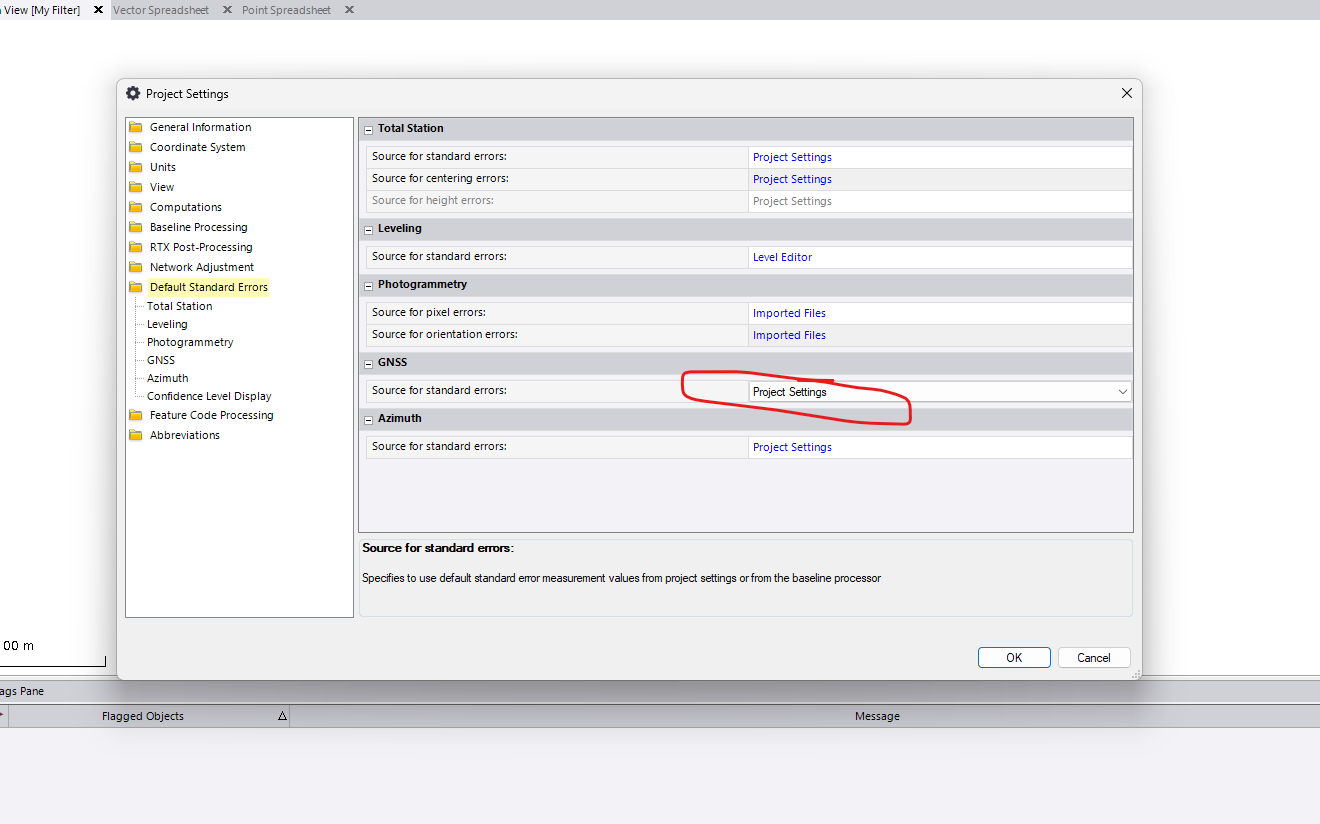
My question, does the "Baseline Processor" setting in TBC incorporate the "Default Standard Error" settings when GNSS data is imported? 

When using a conventional instrument (total-station) in Access a user can setup the centering errors, but not the height errors. When using GNSS in Access there is no option for centering or height errors. 

In TBC, (Project Settings>Default Standard Errors) there are different options for Total-Station and GNSS. The total-station section allows for using the instrument imported files for standard errors or project settings, and the height errors are frozen to project settings. Essentially, you can account for centering and height errors using the combination of both software. 

GNSS on the other hand is a bit different. In Access you have no options for accounting for centering and height errors. In TBC you have only the option to import the "Baseline Processor" or project settings. The Baseline Processing section does not have an option to account for these errors, and it is implied that if you select the "Baseline Processor" in the Default Standard Error" settings that the GNSS project settings will not be included; however, the GNSS project settings is the only place between Access and TBC that centering, and height errors can be inputted. 

#TBC#trimblebusinesscenter

ian bissonnette's profile image
ian bissonnette

i am looking for clarification on this as well. i have the same question but i also want to know more about the source of standard errors for GNSS when it is set to baseline processor. what if there are no baselines in the project, does baselines also refer to information for the rtk vectors??? 

i can sort of answer some of the question, because if you adjust the possible settings for default standard errors for GNSS(centering or standard errors) then it does not change the output of an adjustment when you are set to the baseline processor mode, so it looks like tbc does not use those values in that case. so the question remains, what is it using and what is hidden in this baseline processor mode?? i can see how some standard errors might come from the rtk engine, maybe, but certainly not centering. 

specific to my tiny little project, i can pass the chi square test if i up the horizontal/vertical standard errors to 0.01 and 0.02m, but will fail at 0.005 and 0.01.(about 1.5 ref factor) and fail worse with the baseline processor about 2.0 ref factor.

i just have 4 doubled 30 second rtk shots with about 2cm splits between the shots. 

for this project it does not matter, but when we get into more technical projects i want to know what is going on in this black box 'baseline processor'. 

Robert Hoy's profile image
Robert Hoy

To answer the old question, TA might not have a height error setting if its traverse adjustment is only 2D, or TA's traverse adjustment isn't super robust.  I've only used the traverse adjustment in TBC 2 or 3 times in 15 years and settings in TA are generally for TA's use.

Standard errors in TBC are used in the Network Adjustment, which takes all measurements (when there's redundancy).

The baseline processor is for static baselines, not for RTK vectors. RTK observations are delta x,y,z from your base station and are not static observed satellite data.

In the weighting of the network adjustment, scalars higher than 1 are errors "higher than expected" (which will essentially always be the case for GNSS observations - RTK and post processed vectors.  Lower than 1 are errors that are better than expected, based upon the default error settings. And adjusting default standard errors affects the scalars needed to apply in the weighting.

Here is the part of a network adjustment report from RTK and total station observations, and these are the errors it used:

ian bissonnette's profile image
ian bissonnette

thanks robert, but not exactly what we are asking about. for me, i am using network adjustment. and like sean clearly lays out, you have the option for two types of standard errors for gnss, project settings or baseline processor. the project settings make sense, it will then pull centering/standard errors from the gnss inputs you enter in the tbc setting. but the baseline processor option is confusing. i don't know what info it is pulling from the baseline processor(if any). there are no centering options in the baseline processor. i have a feeling that this terminology is confusing. 
here is one post i found from Ricahard Hassler:

Q: How does network adjustment handle static GNSS, VRS, and RTK data? 

A: Usually you would want to use the Baseline Processor’s error estimates for GNSS data. Post Processed vectors get their error estimates from the TBC processing engine. RTK and VRS vectors get theirs from the engine in the receiver. Different algorithms are used in the different engines and different error estimates are produced. We recognize that real-time kinematic processing frequently has less data to use to estimate vector uncertainties, so we provide a separate scalar in the Weighting Strategies for kinematic vectors so that you can get the relative weighting correct in the minimally constrained adjustment.

AI answer:

When the GNSS source is set to Baseline Processor in the Default Standard Errors settings, ⁠Trimble Business Center (TBC) bypasses any manually entered user-defined project errors for your post-processed vectors. Instead, it uses the unique mathematical uncertainties computed directly by TBC's internal processing engine during baseline calculations. [1, 2, 3]
Understanding how this mode operates relies on three key mechanisms:
1. Source of the Error Estimates
  • Post-Processed (Static) Baselines: The standard errors (vector uncertainties) are extracted directly from the TBC baseline processing engine. They are unique to every single session and vary based on satellite geometry (GDOP), baseline length, occupation time, and signal noise. [1, 2, 3]
  • RTK and VRS Vectors: If you have real-time kinematic data, the baseline processor mode uses the error estimates generated at the moment of capture by the RTK engine inside the field receiver. [1]

seems like that answer from richard makes me think that we should not be using the baseline processor option. 

Robert Hoy's profile image
Robert Hoy

It uses this unless you choose baseline processor